
WAMB文旅推荐▪中国“八朝古都”河南开封
发布时间:2024-09-12
WAMB Cultural and Tourism Recommendation ▪ Kaifeng, Henan Province, known as the "Ancient Capital of Eight Dynasties" in China
Kaifeng has a profound historical and cultural heritage
Kaifeng is one of the first batch of national historical and cultural cities, known as the "ancient capital of eight dynasties". It has a history of more than 4100 years of city and capital construction, including the Wei dynasty in the Xia and Warring States periods, the Later Liang, Later Jin, Later Han, and Later Zhou dynasties in the Five Dynasties period, as well as the Northern Song and Jin dynasties. Especially during the Northern Song Dynasty, Kaifeng was the world's largest city at that time, nurturing the "Song culture" that inherited from the Han and Tang dynasties, and had a profound influence from the Ming and Qing dynasties. Since the Song Dynasty, successive dynasties have regarded Kaifeng as a regional economic and cultural center in northern China. In the long river of history spanning thousands of years, the diligent and wise people of Kaifeng have created a brilliant palace culture, yamen culture, martyr culture, religious culture, folk culture, garden culture, food culture, chrysanthemum culture, opera culture, and calligraphy culture. In the history of Kaifeng, there have emerged famous figures such as Jiao Yulu, a good example of county party secretaries, Bao Gong, an iron faced and selfless general, Yang Jiajiang, a loyal general of the Manchu people, Yue Fei, a national hero, Wang Anshi, a strong reformer, Zhang Zeduan, a painter who defeated Qin and saved Zhao Xinlingjun, Cai Yong, a literary figure, Ruan Ji, an educator, Lin Boxiang, a historian, Fan Wenlan, and a philosopher, Feng Youlan.
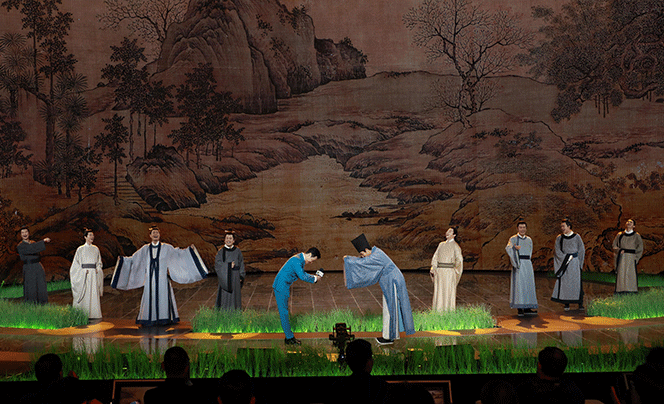
Kaifeng has unique charm in ecological livability
The cultural landscape and natural scenery complement each other, with 12 national 5A and 4A level tourist attractions and 24 national key cultural relics protection units, totaling 27 items. Kaifeng is known as the "Northern Water City", with numerous rivers and lakes within its borders, belonging to the Yellow River and Huai River systems, and surrounded by five lakes and four rivers. The Kaifeng Qingming Cultural Festival held every spring and the China Kaifeng Chrysanthemum Culture Festival held in autumn have attracted numerous domestic and foreign tourists. "April Qingming" and "October Chrysanthemum Fragrance" have become well-known festival brands throughout the country. The hardware foundation, material image, and functional connotation of Kaifeng's internationalization of tourism are becoming increasingly perfect, and an international cultural and tourism city with classical exterior, fashionable interior, prominent Song Dynasty charm, and exquisite beauty is rapidly developing.
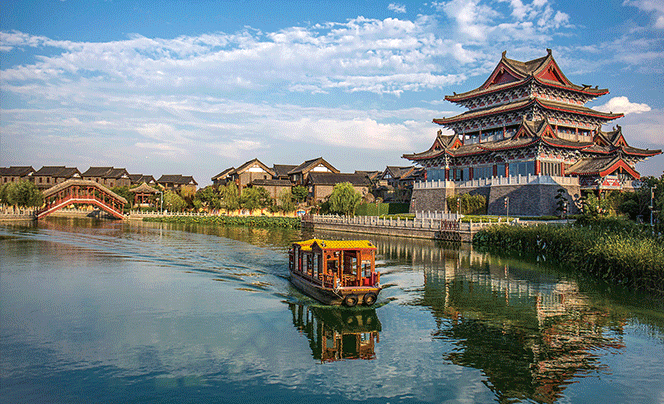
Kaifeng's industries are thriving and flourishing
As the former provincial capital city of Henan, Kaifeng had always ranked among the top in the province in terms of economic output before the 1980s. It was a key investment city during the national "First Five Year Plan" and "Second Five Year Plan" periods, and has produced many "provincial firsts" such as Henan's first television, first refrigerator, first sewing machine, and first bicycle. At present, Kaifeng, as an old industrial base city in central China, is improving the quality and development of traditional industries, cultivating and strengthening emerging industries, and looking ahead to future industries. It is vigorously developing the real economy around high-end chemical, agricultural and sideline product processing, equipment manufacturing, automobile manufacturing, textile and clothing, modern home furnishings, new materials, biomedicine, vanadium flow batteries, energy storage carbon based new materials and other industries. Kaifeng has abundant agricultural resources and is an important production area for wheat, peanuts, and cotton in China. The total grain production has achieved "20 consecutive harvests", with watermelon and peanut production ranking first in Henan and garlic production ranking among the top in the country. It is a major base for planting and exporting wheat, corn, peanuts, garlic, watermelon, and paulownia trees in China. Implementing the project to promote characteristic industries, Lankao County and Xiangfu District have been included in the list of peanut characteristic advantageous industry cluster construction in the province, and Tongxu County has launched the creation of the "Capital of Chinese Sour and Spicy Noodles", becoming the largest sour and spicy noodle production and processing base in the country.
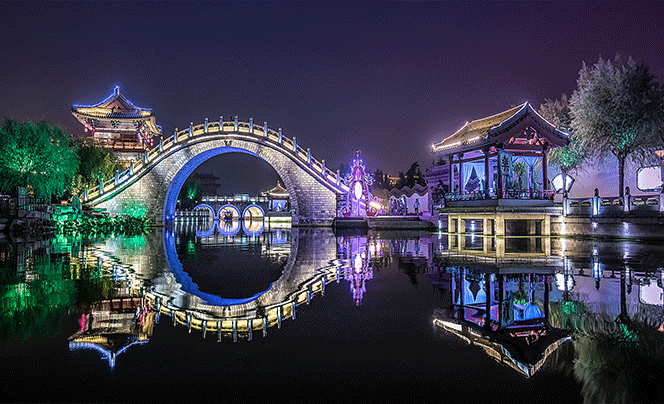
Kaifeng has superior and convenient transportation location
Kaifeng has superior transportation, with the Longhai Railway and Zhengxu High speed Passenger Dedicated Line running through the entire area, and the Beijing Guangzhou and Beijing Kowloon Railways adjacent to each other from east to west; The six highways of Lianhuo, Rinan, Daguang, Zhengmin, Shangdeng, and Anluo are intertwined, with Zhengkai Avenue, Zhengkai Logistics Channel, and Zhengbian Road leading directly to the provincial capital. Kaigang Avenue only takes 30 minutes to reach Xinzheng International Airport; It only takes 26 minutes to reach Zhengzhou High speed Railway East Station by Zhengzhou Kaifeng Intercity Railway, connecting to Zhengzhou Metro. The Zhengzhou Xuzhou high-speed railway has been put into operation, the Longting Station of the Lianhuo Expressway has been completed and opened to traffic, and the "Kaifeng Station" on the extension line of the Zhengzhou Kaifeng intercity railway has been officially listed, highlighting Kaifeng's geographical advantages.
◎ Historical evolution
The activities of the ancestors in Kaifeng can be traced back to the Neolithic Age. Several early Neolithic Peiligang cultural sites have been discovered at the Wanlonggang site in Xiangfu District, Kaifeng City, and the Duantougang site in Fuchuan Town, Weishi County.
The Xia Dynasty established its capital in the Kaifeng area for 217 years from Emperor Zhu to Emperor Xi, known as Laoqiu in history. This is the first time Kaifeng has a clear historical record of its capital establishment. The Shang Dynasty established its capital in the Kaifeng area for 27 years, known as Xiao in history.
In the 8th century BC, during the Spring and Autumn Period, Duke Zhuang of Zheng built a city near Zhuxian Town in the south of Kaifeng City, stationed troops and stored grain, and named it "Qifeng" after the meaning of "opening up and expanding the frontier". In 369 BC, during the Warring States period, King Hui of Wei relocated his capital to Daliang, which is now Gulou District, Kaifeng City. Agriculture and commerce have greatly developed, making Daliang one of the prosperous cities and towns at that time.
In the Western Han Dynasty, Junyi County was established within the territory, and Junyi was used as the name of Kaifeng for about 800 years. In 156 BC, Emperor Jing of the Western Han Dynasty ascended to the throne and changed the name "Qi" to "Kai" to avoid the taboo of Emperor Jing Liu Qi. "Kai Feng" was then renamed "Kaifeng", which is the origin of the city name "Kaifeng".
In the first year of the Tianping reign of the Eastern Wei Dynasty (534 AD), Emperor Xiaojing established Liangzhou, which governed Chenliu, Kaifeng, and Yangxia commanderies. In the fifth year of Jiande reign of Emperor Wu of Northern Zhou (576 AD), Liangzhou was renamed Bianzhou, marking the beginning of Kaifeng being called Bian.
In the fourth year of Emperor Gaozu's Wude reign (621 AD), the Bianzhou General Administration Office was established. In the first year of the Zhenguan reign of Emperor Taizong of Tang (627 AD), Henan Road was established with its administrative center in Junyi County (now Xiangfu District, Kaifeng City). In the first year of Tianbao reign of Emperor Xuanzong of Tang Dynasty (742 AD), Bianzhou was temporarily renamed as Chenliu Commandery. In the 14th year of the Dali reign of Emperor Tang Dynasty (779 AD), Li Mian, the military governor of Yongping, expanded the city of Bianzhou, which was grand in scale, sturdy and broad, and became the prototype of today's Kaifeng city.
During the Five Dynasties period, the Later Liang, Later Jin, Later Han, and Later Zhou successively established their capitals in Kaifeng, which was called the "Eastern Capital" or "Tokyo". In the 17th year of the Later Liang Dynasty's capital establishment in Kaifeng, the political, economic, cultural, and military center of northern China shifted from Luoyang in the Heluo region to Kaifeng in the eastern Henan Plain.
In the first year of Jianlong in the Northern Song Dynasty (960 AD), Zhao Kuangyin established the Song Dynasty, known as the Northern Song Dynasty, with its capital in Dongjing and 17 counties under the jurisdiction of Kaifeng Prefecture. During the Northern Song Dynasty, Kaifeng lasted for 168 years under the Nine Emperors and had a population of over one million. It was prosperous and flourishing, reaching its peak and becoming the political, economic, and cultural center of the country. It was also one of the most prosperous metropolises in the world at that time. The famous Northern Song painter Zhang Zeduan's "Along the River during Qingming Festival" and the literary figure Meng Laoseng's "Dreams of Splendor in Dongjing" vividly depict the bustling scene of Kaifeng at that time.
In the second year of the Jingkang reign of the Song Dynasty (1127 AD), after the Jin Dynasty conquered the Northern Song Dynasty, Dongjing was renamed Bianjing. In the first year of the Jin Dynasty's Zhenyuan era (1153), Wan Yanliang moved the capital to the central capital of Daxing Prefecture and renamed Bianjing as "Nanjing Kaifeng Prefecture", becoming the capital of the Jin Dynasty.
At the beginning of the Yuan Dynasty, following the name of the Jin Dynasty, it was still called Nanjing Road. In the 25th year of the Zhiyuan era (1288 AD), Nanjing Road was renamed Bianliang Road and became the provincial capital of Jiangbei Province in Henan Province. At the end of the Yuan Dynasty, the Red Turban Rebellion led by Han Shantong and Liu Futong established the "Dragon and Phoenix" peasant government of the Song Dynasty in Kaifeng.
In the first year of the Hongwu reign of the Ming Dynasty (1368 AD), Zhu Yuanzhang renamed Bianliang Road as Kaifeng Prefecture, merged Kaifeng County into Xiangfu County, and established the Henan Zhongshu Provincial Government with Kaifeng Prefecture as its capital. In the same year, Kaifeng Prefecture was upgraded to Beijing and placed as the capital. In the eleventh year of the Hongwu reign (1378 AD), the title of Beijing was abolished. In the 14th year of the Hongwu reign (1381 AD), King Zhu Xi of Zhou was appointed to establish a fiefdom in Kaifeng. The Qing Dynasty inherited the Ming system, but removed the feudal lords, and Kaifeng remained the capital of the province and prefecture.
The Republic of China underwent restructuring, abolishing Kaifeng Prefecture and establishing Yudong Road. Xiangfu County was renamed Kaifeng County, and Kaifeng became the capital of Henan Province and the administrative center of Yudong Road. In the third year of the Republic of China (1914 AD), Yudong Road was renamed Kaifeng Road. Kaifeng City was established in 1929 during the 18th year of the Republic of China. In 1938, the Henan Provincial Committee of the Communist Party of China was established in Kaifeng. In the same year, eastern Henan fell and the Japanese army occupied Kaifeng. The provincial capital moved westward, and the following year, the Japanese puppet National Government established the puppet Henan Provincial Government in Kaifeng City. In 1945, Japan surrendered and the Nationalist Government restored the establishment of the Henan Provincial Government in Kaifeng.
